
Too much stomach acid–or too little?
Updated: 1/28/2025
(Click here to receive a downloadable .pdf of this blog post)
The hydrochloric acid in our stomachs is supposed to be so acidic that it would burn our skin if any got on it!
There are a number of reasons our stomachs are this acidic (1) such as:
- to stimulate the pancreas to make digestive enzymes so we can better break down our food
- to stimulate the gallbladder to secrete bile to emulsify the fats in our diet
- to prevent systemic inflammation and leaky gut by breaking down food proteins into smaller amino acids so that undigested foods are recognized as dangerous invaders by the gut’s immune system
- to begin the digestion of protein so that it can be more easily broken down by digestive enzymes in the small intestine
- to absorb minerals like iron, calcium, magnesium, zinc, and copper
- to sterilize the small intestine to prevent bacterial overgrowth or SIBO
- to be our first line of defense against food poisoning, H pylori, parasites, fungi, and other infections.
But did you know that a lot of people aren’t producing enough stomach acid? And the crazy thing is they are very likely to think they are producing too much stomach acid instead!
That is because, in a roundabout way, having too little stomach acid can actually cause the same symptoms as having too much stomach acid.
Here’s what happens. . .
The primary purpose of our stomach acid (HCL) is to break down the protein that we eat. But, if there is not enough HCL in the stomach, the food doesn’t get to go on down to the small intestine as it should. Instead, the protein begins to putrefy and ferment in the stomach, creating organic acids and causing the stomach environment to become too acidic.
In addition, the food or acidic stomach juice can come up (often called reflux), which makes you think you have too MUCH stomach acid.
In a nutshell, the symptoms of too much stomach acid were caused by having too little stomach acid. And too little stomach acid means that the functions the stomach acid was supposed to do (such as breaking down protein, aiding in the absorption of minerals, and protecting us against food poisoning, H pylori, fungi and parasites, etc.) doesn’t happen.
Causes of Low Stomach Acid:
- No energy to produce stomach acid–this is often caused by FOOD SENSITIVITIES and/or STRESS—because our bodies are so busy putting out other fires that they just don’t have the energy to make HCl.
- Mineral deficiencies–a diet high in PROCESSED FOODS can cause mineral deficiencies which in turn can cause decreased production of HCl.
- Environmental and other factors–smoking, alcohol, caffeine, a high-carb diet, some medications, and even chlorine and fluoride in drinking water can decrease HCl production. Also, we make less HCl as we age, and an underactive thyroid can even play a role.
- Unmanaged hypothyroidism–the stomach depends on sufficient thyroid hormone to produce HCl and the brain depends on thyroid hormone to communicate efficiently with the digestive organ
Symptoms of Low Stomach Acid:
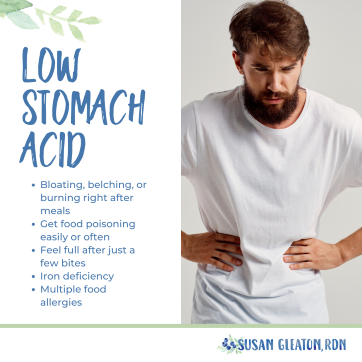
- Bloating, belching, burning, or flatulence 30-60 minutes after meals, especially protein
- Sense of fullness after only a few bites of food
- Feeling as though food sits in the stomach for hours
- Heartburn or acid reflux
- Indigestion, diarrhea, or constipation
- Multiple food allergies
- Nausea after taking vitamins or supplements
- Desire to eat when not hungry
- Itching around the rectum
- Weak, peeling, and cracked fingernails
- Fatigue
- Chronic intestinal parasites
- Undigested food in stool
- Nutrient deficiencies–iron, B12, calcium, magnesium
- Chronic candida infections
Too little stomach acid can set you up for SIBO, fungal or parasitic infections, poor protein digestion, and/or poor mineral absorption.
Too much stomach acid, or having stomach acid in the wrong place, can lead to erosion of the esophagus.
The Apple Cider Vinegar Challenge
When you have low stomach acid, it’s helpful to take supplemental hydrochloric acid (HCl) to support digestion while you figure out WHY you have low stomach acid in the first place and address the reasons for the deficiency.
However, because symptoms of low and high stomach acid are very similar, you will want to make sure that HCl supplementation is the right thing for you. Though there is no research that documents its effectiveness, many clinicians find The Apple Cider Vinegar Challenge to be helpful in determining if taking HCl is right for you.
NOTE:
If you are currently taking proton pump inhibitors or acid-blockers, do not do this self-test.
The Apple Cider Vinegar Challenge
Perform the ACV Challenge on an empty stomach—at least 3 hours after you have eaten or (preferably) first thing in the morning.
Procedure:
- Add 2 oz undiluted apple cider vinegar to 4 oz water.
- Down it (yep—drink as fast as you can).
- Observe your reaction.
Within 2-5 minutes, do you feel:
- A mild warming sensation? Your stomach acid is good!
- An immediate strong burning sensation? Your stomach acid is too high or you have gastric irritation or an ulcer and need to work on repair. (You can lessen symptoms by neutralizing the milk or a little baking soda dissolved in water.)
- No burning sensation at all, your stomach acid is too low (see below “How to supplement with HCl”).
Helpful Tips:
- Do this test with someone else so you can compare sensations.
- Have some food ready for you to eat right afterward to ward off any feelings of nausea that may occur.
How to Supplement with HCl
If you determine that your stomach acid is too low, it is very helpful to supplement with HCl while you work on the root cause or reason why, it is too low. (2)
To determine the right dose for you:
- Take one capsule (500 mg) HCl with a protein-containing meal. A brand I often recommend is Thorne Betaine HCl & Pepsin. You can find this in my Fullscript On-line Dispensary where I offer a 20% discount
- Increase by one capsule per protein-containing meal until you experience burning or discomfort. If eating a small meal, do not increase the dosage. Do not exceed 4 capsules (2000 mg).
- Back down to the dose where you did not experience burning.
The goal is to take as much, but no more, HCl as you need. You may find you can lower your dose over time as you take care of the underlying cause of your low stomach acid.
How to Address the Root Cause of Low Stomach Acid
FIRST, determine why. Ask yourself these questions:
- Do you have food sensitivities that are taxing the body, inhibiting the production of HCl?
- Are you under too much stress?
- Is your diet full of processed foods depleting your body of minerals needed to produce HCl?
- Do you smoke?
- Are you drinking a little too much caffeine or alcohol?
- Is your drinking water full of chlorine or fluoride?
- Do any of your medications lower stomach acid?
- Is your diet high in carbohydrates and low in protein?
- Do you have an underactive thyroid?
- Are you over 50?
NEXT, do something about it.
All these things can result in less HCl production, so take care of the things you have control over. We can’t slow down aging, but can you:
- Test for food sensitivities.
- Reduce your stress by restructuring your life, making new priorities, or learning to deal with it better.
- Eat real, whole foods instead of processed.
- Stop or cut back on smoking.
- Cut back on caffeine and/or alcohol.
- Filter your drinking water.
- Eat a Mediterranean-style diet with moderate protein, lower carbs, and healthy fats.
- Have your thyroid levels checked.
It takes time to make these changes, but if you don’t take care of the root cause of why you have low stomach acid, you’re just bailing water out of a canoe with a hole in it, which gets you nowhere!
Watch for my next post, 6 Ways To Increase Stomach Acid (HCl) Naturally, for things you can do to increase your stomach acid while you’re working on any of the above changes that need to be done.
(Click here to receive a downloadable .pdf of this blog post)
Sources:
(1) Gastric acid secretion, Curr Opin Gastroenterol; 2016 Nov;32(6):452-460.
(2) Guilliams TG, Drake LE. Meal-Time Supplementation with Betaine HCl for Functional Hypochlorhydria: What is the Evidence (https://www.ncbi.nlm.nih.gov/pmc/articles/PMC7238915/)? Integr Med (Encinitas). 2020;19(1):32-36. Accessed 6/27/2022.